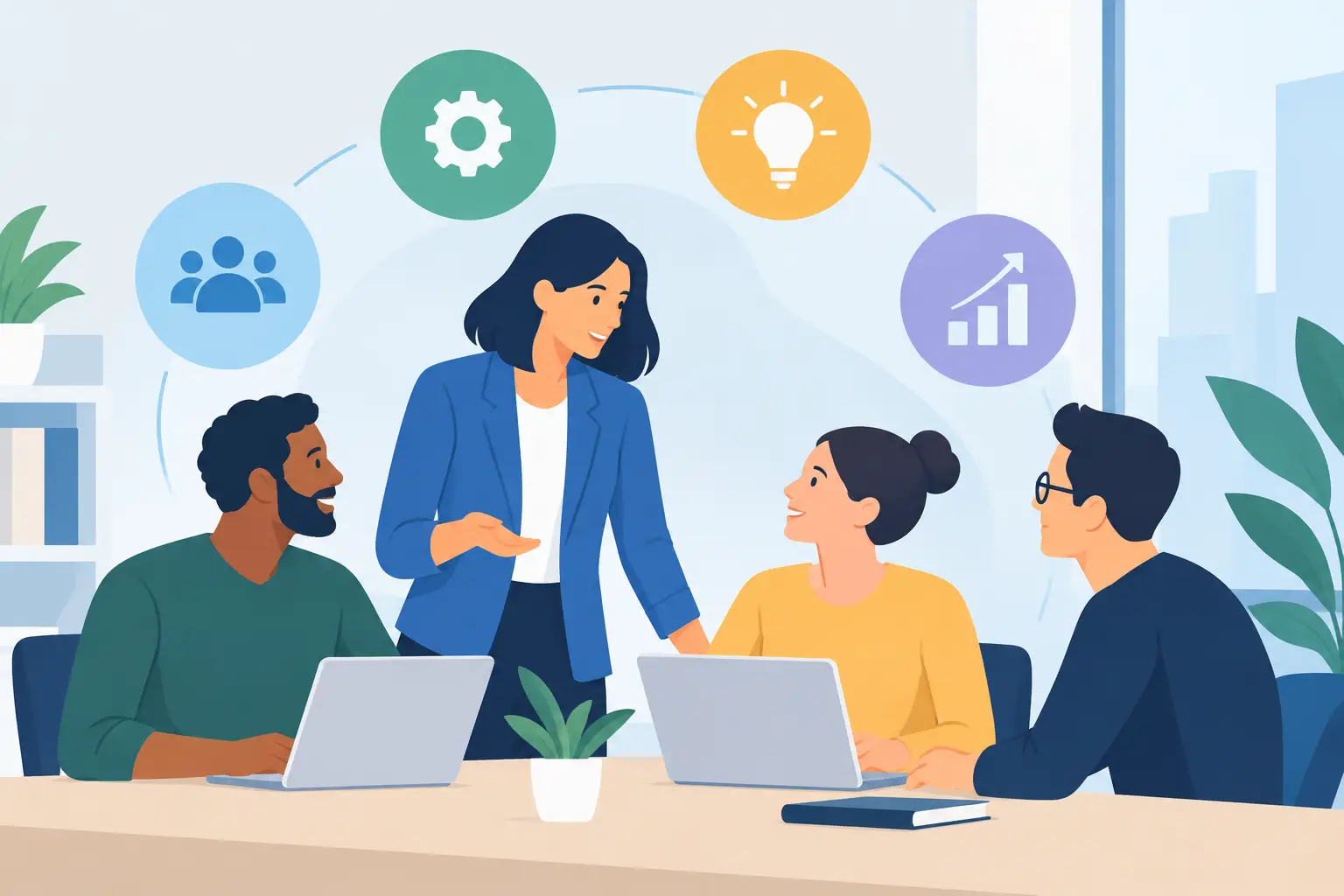
A new performance process is due before the next review cycle. An HRIS rollout is stuck on adoption. A leadership program needs to reach managers in six weeks, not six months. The work is clear. The internal capacity is not. That gap is where workforce enablement becomes a business issue, not just an HR or learning issue.
So, what is workforce enablement? It is the work of making people able, ready, and supported to do what the business needs them to do. It brings together the systems, skills, processes, tools, and support that help employees perform well through change and growth.
For senior leaders, the key point is simple: workforce enablement is not one program or one team. L&D, HR, and Talent each own part of the work. When they operate in separate lanes, employees get mixed messages and leaders get slow execution. When they work from shared business priorities, the organization can build capability and remove friction at the same time.
When a priority needs specialized help, talk to a vetted L&D, HR, or Talent expert on Learnexus. The right independent specialist can help a team move from a defined need to project kickoff in days, without adding permanent headcount or waiting through a long agency process.
What workforce enablement means in practice
Workforce enablement is often confused with workforce development. The two are related, but they are not identical. Workforce development focuses on growing skills and preparing people for future roles. Workforce enablement is broader. It includes development, but it also addresses the conditions that let people use those skills.
A sales manager may complete coaching training, for example. That is development. But if the performance system does not reinforce coaching, managers have no time in their calendars, and HR business partners use different expectations, the training will not change much. Enablement connects those pieces.
It asks practical questions: Do people know what good looks like? Do they have the skills to deliver it? Are managers equipped to reinforce it? Do workflows, technology, and policies make the desired behavior easier or harder? Can leaders see whether the effort is working?
The answer varies by business need. A company integrating a new workforce after an acquisition may focus on change management, manager communications, HR process design, and culture integration. A company shifting to skills-based hiring may need a skills framework, recruiter training, assessment design, workforce planning, and better data in its HR systems. Neither effort succeeds through a single workshop.
The three functions behind workforce enablement
Effective enablement is shared work, with clear roles for L&D, HR, and Talent. Each function brings a different lever.
L&D builds job-ready capability
L&D turns business requirements into learning experiences that help people perform. This can include onboarding, manager development, product training, compliance education, technical upskilling, and learning measurement. The strongest L&D teams do not start with a course request. They start with the performance gap.
If frontline leaders are not conducting quality career conversations, the answer may include a short practice-based learning program. It may also require conversation guides, manager tools, a change plan, and data from employee listening. An instructional designer, facilitator, learning strategist, or learning operations specialist can fill specific gaps when the internal team is at capacity.
HR creates the operating conditions
HR enables performance through the employee experience and the systems behind it. That includes HR operations, HRIS design, total rewards, policy, organizational design, compliance, and change management.
Consider an HRIS implementation. The technical configuration matters, but adoption determines whether the system improves work or creates more tickets and workarounds. Workforce enablement means defining new processes clearly, preparing managers and employees, aligning communications, and building support into the launch. A specialist with experience in HRIS implementation and change can prevent an internal team from learning expensive lessons mid-project.
Talent connects people decisions to future demand
Talent teams help the business decide which capabilities it needs, where it has gaps, and how it will build or acquire them. Their work spans talent acquisition, workforce planning, performance management, succession, engagement, retention, and people analytics.
A succession plan, for instance, is not enabled because names appear on a chart. It works when roles have clear success profiles, potential is assessed consistently, development plans are real, and leaders regularly act on the data. Talent experts can bring structure to this work when a company is building a new process, facing a leadership transition, or lacks a niche capability in-house.
Why workforce enablement breaks down
Most teams do not fail because they lack commitment. They fail because urgent work arrives faster than capacity, or because a complex initiative gets treated as a functional project instead of a business change.
The first problem is fragmented ownership. L&D may build training while HR changes policies and Talent updates performance expectations, but the timing and language do not match. Employees receive several messages and no clear picture of what changes for them.
The second is an expertise gap. A team may be excellent at running core programs but need a short-term expert in skills architecture, compensation design, learning measurement, workforce analytics, or organizational change. Hiring a permanent role may not fit the need. Asking an internal generalist to stretch into a specialized project can add risk and delay.
The third is slow sourcing. Traditional consulting procurement can take months, especially when leaders need proposals, approvals, and multiple rounds of vendor review. By the time help arrives, the business deadline has moved. Generic freelance sites create the opposite problem: plenty of profiles, but too much uncertainty about enterprise experience, methodology, and fit.
How to make workforce enablement operational
Start with the business event, not the function. A new operating model, rapid growth plan, technology launch, retention risk, or leadership gap creates a workforce requirement. Define what must change in behavior, capability, or process, then identify which parts belong to L&D, HR, and Talent.
Next, separate work that should stay internal from work that needs outside depth. Internal leaders should own business context, stakeholder decisions, and long-term accountability. Outside experts are most useful when the work is specialized, time-bound, or urgent. Examples include designing a skills taxonomy, rebuilding performance management, configuring learning technology, preparing leaders for a major change, or creating a succession process.
Then set measures before the project starts. Completion rates alone rarely prove enablement. Better measures depend on the initiative: time to proficiency for new hires, manager adoption of a new process, internal fill rates for critical roles, employee retention in key groups, reduction in HR process errors, or usage of a new system. Choose a small set that leaders can review without building a separate reporting exercise.
Finally, plan for reinforcement. Workforce enablement is not complete at launch. Managers need tools and reminders. Employees need a clear place to get help. HR and Talent teams need feedback loops that show where a process is failing. L&D needs evidence of whether learning is transferring to the job. The best programs adapt after launch rather than defending the original plan.
When outside expertise is the right move
Outside support is not automatically the answer. If the work is ongoing, central to your operating model, and likely to grow, building internal capability may be the better choice. But a flexible bench is valuable when a high-priority initiative needs a skill your team does not use every day.
The practical advantage is focus. A seasoned independent expert can bring proven methods, challenge weak assumptions, and produce a defined outcome without creating another permanent layer in the organization. That is especially useful for projects with a clear finish line, such as an HR transformation phase, a learning program build, a workforce planning cycle, or a performance management redesign.
Quality matters more than access alone. Look for specialists with deep experience in the specific problem, not just a broad title. Ask how they have handled stakeholder alignment, measurement, compliance needs, and handoff to internal owners. A strong match should reduce ramp-up time while leaving your team more capable after the work is done.
Workforce enablement earns its value when employees can act with more clarity and confidence, and the business can execute without waiting for the perfect internal resourcing plan. The next urgent priority will not wait for a new headcount. Build the partnerships and expert bench that let your team respond when it arrives.