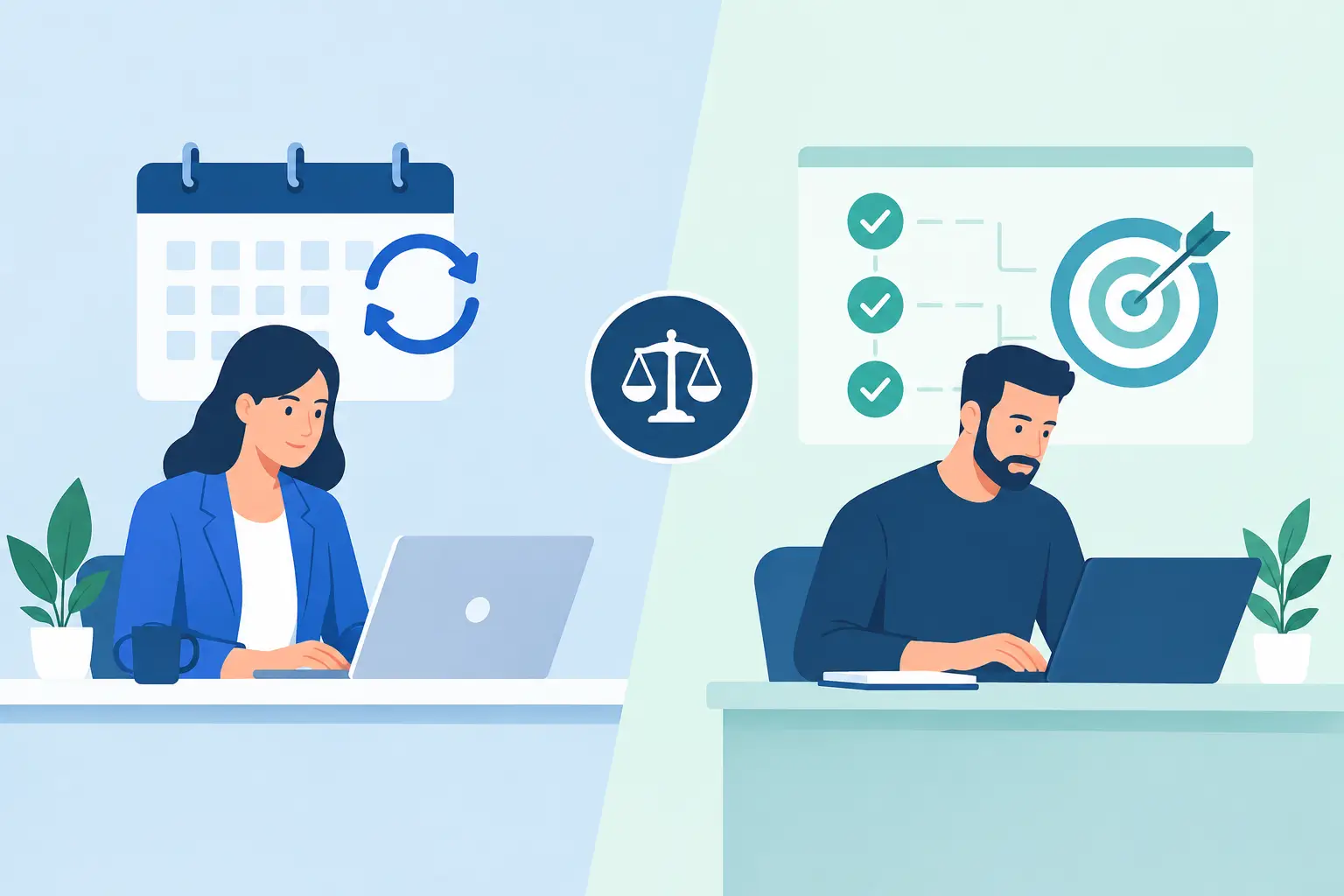
A compliance launch is six weeks away. Your LMS needs a new learning path, 12 modules require localization, and legal has changed the policy language twice. That is not the moment to debate a year-long vendor relationship. Retainers versus project engagements is a practical operating decision for L&D leaders: how should you buy specialized capacity without slowing down delivery or carrying unnecessary cost?
The right answer depends on the shape of the work, not a universal preference. Project engagements create focus, defined accountability, and clean financial boundaries. Retainers create continuity, faster access to an expert, and capacity for work that does not arrive on a predictable schedule. High-performing L&D teams use both models intentionally.
Retainers Versus Project Engagements: The Core Difference
A project engagement is built around a defined outcome. You agree on the scope, deliverables, timeline, milestones, and acceptance criteria before work begins. An instructional designer might redesign a manager onboarding program. An LMS architect might migrate learning content and configure reporting. An eLearning developer might produce a set of compliance modules in Articulate Storyline.
A retainer reserves a consultant's time or access over an agreed period, usually monthly or quarterly. The work may be planned, but the value is often responsiveness and continuity. Your learning strategist can advise on a shifting academy roadmap, your developer can make production updates as product releases change, or your facilitator can support recurring leadership cohorts.
The distinction matters because these models manage risk differently. A project controls scope risk. A retainer controls availability risk. If your biggest concern is unclear work volume or losing a trusted specialist when priorities shift, a retainer may be worth the committed spend. If the work has a clear finish line, a project usually delivers better cost discipline.
When a Project Engagement Is the Better Buy
Choose a project engagement when the business need is concrete and the finish line can be described in plain language. This is common when an L&D team has a defined deliverable, a fixed launch date, and internal stakeholders who can make decisions quickly enough to prevent delays.
A project model works especially well for a new sales enablement curriculum, a learning experience platform implementation, a certification program refresh, a leadership workshop design, or a targeted accessibility remediation effort. It lets you source for the exact capabilities required rather than paying for broad, ongoing coverage.
The commercial advantage is clarity. You can compare proposals against the same statement of work, approve a budget tied to milestones, and evaluate success against agreed outputs and learning measures. Procurement has a cleaner path, finance has a known commitment, and the consultant has the authority to focus on delivery rather than waiting for a weekly queue of requests.
That clarity only holds when the scope is real. A project engagement struggles when stakeholders call everything a small revision, decision rights are unclear, or upstream changes continue after production begins. In those cases, fixed fees can produce change orders, friction, or rushed work. A project is not automatically lower risk if the organization cannot define what it needs.
Build the brief before you source
The strongest project briefs define the business problem, audience, delivery environment, required expertise, decision makers, timeline, and measures of success. For example, “build onboarding” is not enough. “Create a six-module, mobile-first onboarding path for 800 field service hires, integrated into Cornerstone, with a 45-day launch target” gives specialists a basis for estimating effort and surfacing risks early.
This also helps you avoid buying the wrong level of talent. A straightforward Storyline build may need a production specialist. A high-visibility behavior-change initiative may require an instructional design lead who can conduct discovery, align executives, define measurement, and direct production. Better scoping leads to faster matching and fewer expensive corrections.
When a Retainer Creates More Value
A retainer is a better fit when work is continuous but difficult to forecast precisely. Many enterprise L&D functions face this reality. Product updates trigger training revisions. Acquisitions create sudden enablement needs. A global learning team needs recurring design support across regions. Your internal team is capable, but one specialist gap repeatedly slows the roadmap.
With a retainer, you are not simply purchasing hours. You are securing context. An experienced consultant learns your audience, brand standards, authoring tools, approval process, learning data, and stakeholder dynamics. That reduces ramp-up time every time a new request lands.
This is particularly valuable for scarce capabilities. A learning analytics specialist, AI learning strategist, LMS architect, or senior leadership development consultant may be needed regularly, but not at a full-time level. A retainer gives the organization reliable access without a permanent hire, agency markup, or repeated sourcing cycle.
Retainers need governance to work. Without it, they can become a vague promise of help, with unused hours one month and an overloaded consultant the next. Set a monthly capacity range, define response expectations, establish what work is included, and hold a regular prioritization meeting. Treat the consultant as an extension of your operating model, not an emergency inbox.
Watch for the hidden cost of “as needed”
Some teams avoid retainers because they do not want to commit before every request is known. That is reasonable when demand is genuinely occasional. But repeated ad hoc sourcing has its own cost: intake meetings, vendor screening, contracting, knowledge transfer, and quality uncertainty. If you have hired for the same specialty three times in six months, the work may no longer be ad hoc.
The real comparison is not retainer cost versus zero cost. It is retainer cost versus the full operational cost of restarting the search each time. For urgent, high-stakes work, days matter. Waiting weeks for an agency proposal or cycling through unvetted freelancers can put a launch at risk before production begins.
A Simple Decision Test for L&D Leaders
Use four questions to determine the right engagement model:
- Can we define the deliverables, timeline, and acceptance criteria now?
- Is this expertise needed repeatedly over the next three to six months?
- Would a new consultant need significant context before producing useful work?
- Is speed of response more valuable than a tightly fixed scope?
If the first answer is yes and the remaining answers are mostly no, start with a project engagement. If repeat demand, organizational context, and response speed dominate, a retainer is likely the stronger model. When the answers are mixed, use a hybrid approach.
A hybrid often begins with a discovery or build project, then shifts to a smaller retainer for optimization, maintenance, measurement, and new requests. For instance, engage an LMS architect to complete an implementation project, then retain that architect for release support, administrator coaching, reporting improvements, and integration changes. You get project-level accountability during the critical build and continuity once the platform is live.
How to Protect Quality in Either Model
The engagement structure cannot compensate for weak talent matching. A generalist may be less expensive on paper but costly in rework if they lack experience with your learner population, technology stack, compliance requirements, or enterprise review process.
Source specialists based on demonstrated outcomes, not job titles alone. Review relevant portfolios. Ask how they approach adult-learning design, stakeholder alignment, accessibility, measurement, and risk management. Confirm they have worked at the level of complexity your organization requires. A facilitator who excels in small-team workshops may not be the right fit for a global leadership rollout. An excellent content developer may not be the person to architect your learning ecosystem.
This is where a vetted specialist marketplace can shorten the path. Learnexus helps L&D teams identify experienced independent experts by capability, platform, industry, and project need, so teams can move from brief to qualified conversations in days rather than months. The commercial model still matters, but a strong match gives either model a better chance of delivering measurable value.
For project engagements, establish milestone reviews that assess learning quality as well as production status. For retainers, review utilization, priorities, outcomes, and upcoming capacity every month. In both cases, name one internal owner who can make decisions and remove blockers. External expertise moves quickly only when internal governance does too.
The best choice is the one that lets your team act with confidence when the next business priority arrives. Define what is known, reserve capacity where continuity matters, and leave room to change the model as the work changes.