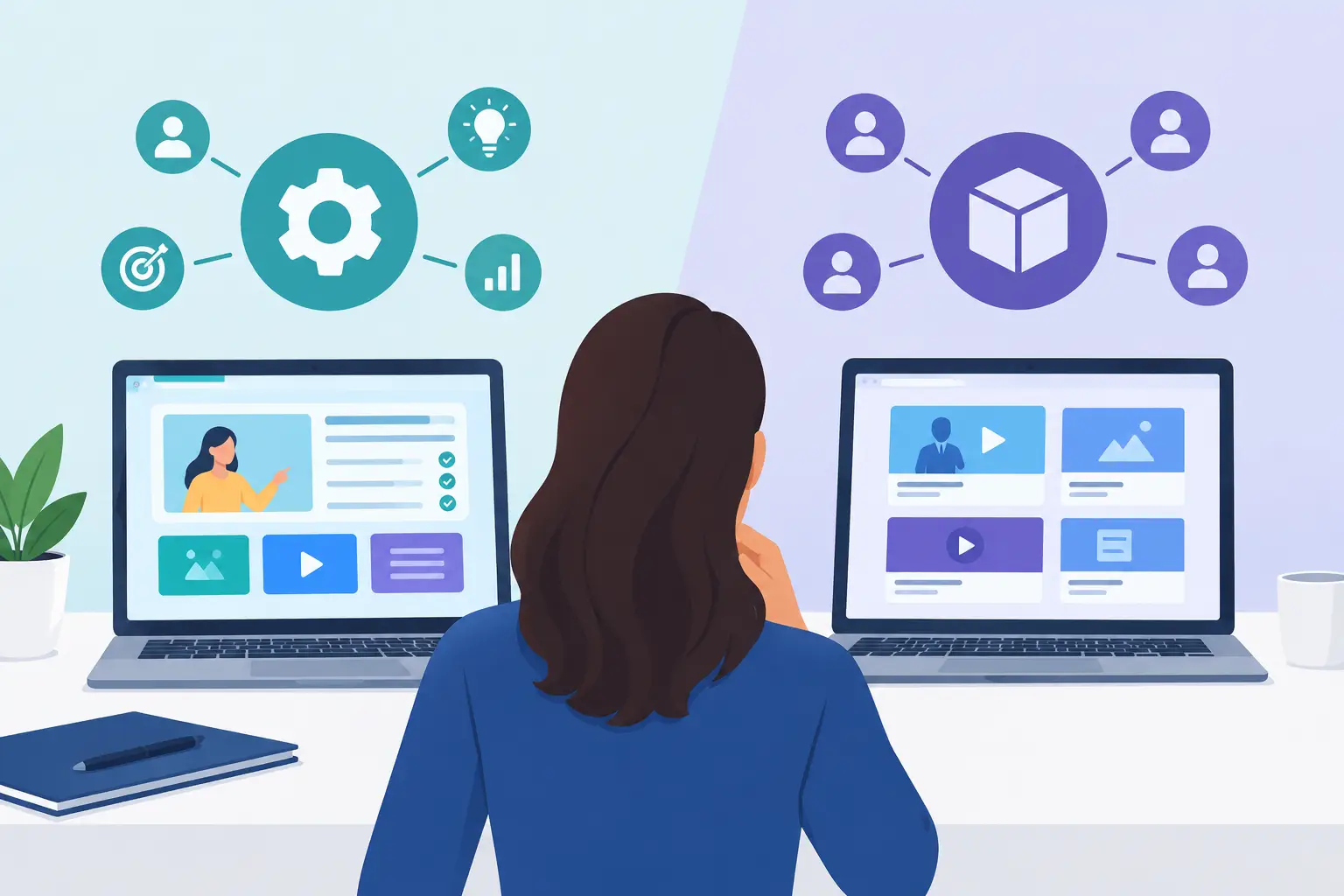
A safety incident, a new manager standard, an HRIS rollout, or a skills-based transformation rarely arrives with six months of lead time. That is why the custom eLearning versus off the shelf decision cannot be treated as a content preference. It is an operating decision: how quickly can your organization change behavior, prove readiness, and support the business without wasting budget on training people will not use?
Off-the-shelf courses can get a credible baseline into the LMS quickly. Custom eLearning can turn your specific workflows, systems, policies, and decisions into performance support that employees recognize immediately. Neither model wins by default. The right choice depends on the consequence of getting the behavior wrong, the shelf life of the content, and the level of organizational change at stake.
Custom eLearning Versus Off the Shelf: The Real Difference
The simplest distinction is relevance. Off-the-shelf content is built for a broad market. It covers common capability areas such as communication, harassment prevention, cybersecurity awareness, Excel, project management, leadership fundamentals, and compliance topics. The vendor has already absorbed the design and production cost, so organizations can license it and deploy it rapidly.
Custom eLearning is built around a defined performance need inside your organization. It may use your terminology, customer scenarios, product screens, policy rules, manager expectations, or operating procedures. A well-designed custom program does more than add a company logo to generic content. It identifies the decisions employees must make, the mistakes that create risk or rework, and the practice needed to perform correctly on the job.
That distinction matters because completion is not the same as capability. If the goal is awareness, broad content may be enough. If the goal is consistent execution during a high-stakes operational change, generic content often leaves the most important questions unanswered: What does this mean here? Which system fields matter? Who approves an exception? What does good look like in our manager cadence?
When Off-the-Shelf Training Is the Smarter Buy
Choose off-the-shelf when speed and breadth matter more than organizational specificity. It is particularly effective when the subject is stable, universally understood, and not central to your competitive advantage.
A national organization that needs immediate access to cybersecurity awareness or foundational people-manager learning should not automatically commission a bespoke course. A strong library can provide quality instruction, assessments, reporting, and multilingual options within days. It also makes sense for large audiences with varied roles where the desired outcome is a shared vocabulary rather than a tightly prescribed workflow.
Off-the-shelf is also useful as a diagnostic tool. Before funding a major leadership academy, for example, an L&D team can use ready-made courses to establish foundational knowledge while gathering performance data and stakeholder feedback. The results can reveal where a custom intervention is actually warranted.
The trade-off is that off-the-shelf content may ask employees to translate generic concepts into local practice on their own. That is manageable for low-risk topics. It becomes expensive when adoption depends on role-specific judgment, complex systems, or a new way of working.
When Custom eLearning Earns Its Cost
Custom eLearning is the stronger investment when training is directly tied to execution, risk reduction, or a material transformation. Common examples include an ERP or HRIS implementation, a new sales process, regulated procedures, manager-led performance management changes, a redesigned onboarding journey, or a customer-facing product launch.
In these cases, employees do not need another explanation of general principles. They need to practice the exact tasks and decisions that will determine whether the initiative succeeds. A custom simulation can place an HR business partner in a realistic employee-relations scenario. A branching exercise can ask a frontline manager to respond to a performance issue under the new policy. System walkthroughs can show users the specific steps required in your own environment.
Custom content also creates alignment before launch. The design process forces stakeholders to agree on the target behavior, escalation paths, language, and standards of performance. That work can expose policy gaps and conflicting expectations early, before thousands of employees receive inconsistent guidance.
The cost is not just production. Custom development requires access to subject matter experts, clear decision rights, timely reviews, and disciplined governance. If leaders cannot provide those inputs, a custom project can become a slow series of opinion cycles disguised as content development. The best design partner will protect the scope, challenge unnecessary content, and keep the program focused on measurable behavior.
Compare Cost Beyond the License Fee
Off-the-shelf usually has the lower upfront price. But an annual library license is not automatically the lower-cost choice if utilization is weak, learners cannot see the relevance, or managers must create their own local reinforcement to make the material stick.
Custom eLearning has higher initial cost because research, instructional design, visual design, development, quality assurance, and project management are tailored to the organization. Yet its economics improve when the program serves a large audience, remains relevant for multiple years, or prevents expensive errors. A custom course that shortens system adoption, reduces compliance failures, or cuts manager rework can justify its investment quickly.
The more useful financial question is: what does failure cost? For a low-stakes course on presentation skills, a premium custom build is difficult to defend. For training that supports a multimillion-dollar technology deployment or a compliance obligation, underinvesting in relevance can be the more costly decision.
Also account for maintenance. If your process or software changes every quarter, a highly produced custom course may age quickly. In that case, modular learning assets, concise performance support, and configurable vendor content may deliver a better return than a long, cinematic course.
A Practical Decision Framework for L&D Leaders
Use four tests before choosing a development path.
First, assess specificity. If people must apply your policies, systems, products, or customer scenarios, move toward custom. If the content teaches transferable knowledge that does not change by organization, off-the-shelf is likely sufficient.
Second, assess consequence. The greater the safety, regulatory, financial, customer, or employee-relations risk, the more valuable scenario-based practice and organization-specific guidance become.
Third, assess urgency. A ready-made course can launch almost immediately. But urgency does not always mean buy a library. For a high-priority rollout, a focused custom microlearning package can often be designed faster than a large course catalog can be evaluated, procured, configured, and embedded into a change plan.
Fourth, assess durability. Invest in custom when the core process will remain stable long enough to generate returns. For fast-changing content, build small, editable assets and pair them with job aids, manager toolkits, and live reinforcement.
The Hybrid Model Often Delivers the Best Outcome
Many enterprise learning teams do not need to choose one model for every need. They use off-the-shelf content for broad foundational capabilities, then reserve custom investment for the moments that differentiate performance.
Consider a manager development initiative. A quality off-the-shelf library can cover coaching, feedback, delegation, and inclusive leadership. Custom components can then address your performance cycle, compensation conversations, employee relations escalation process, and leadership expectations. Employees get proven foundational instruction without forcing them to infer how it applies at your company.
The same approach works for HR transformation. A general change-management module may establish common language. Custom role-based learning, system simulations, and leader communications can drive adoption of the new operating model. This is not compromise. It is portfolio discipline.
Get the Build Strategy Right Before You Source
A common mistake is issuing a request for a custom course before defining the business problem. Start with the audience segments, required on-the-job behaviors, business measures, source materials, technology constraints, accessibility requirements, and review process. Then determine whether the solution requires custom design, curation, configuration, or a blended approach.
This clarity makes external expertise more valuable. An experienced instructional designer, eLearning developer, learning strategist, LMS architect, or change-management consultant can challenge assumptions before production begins. Learnexus gives L&D, HR, and Talent leaders direct access to rigorously vetted independent specialists, helping teams move from a defined need to the right expertise in days rather than waiting through an agency sourcing cycle.
Do not judge a partner solely by a visual portfolio. Ask how they conduct needs analysis, design practice, manage SME reviews, test accessibility, measure transfer, and handle future updates. Attractive screens do not fix weak learning objectives or ambiguous business processes.
The best choice is the one that puts the right level of investment behind the behavior your business needs next. Use off-the-shelf content to move fast on common needs. Use custom eLearning where your people must execute differently, consistently, and with confidence. Then measure what changed after the course ends, because that is where the investment either proves itself or does not.