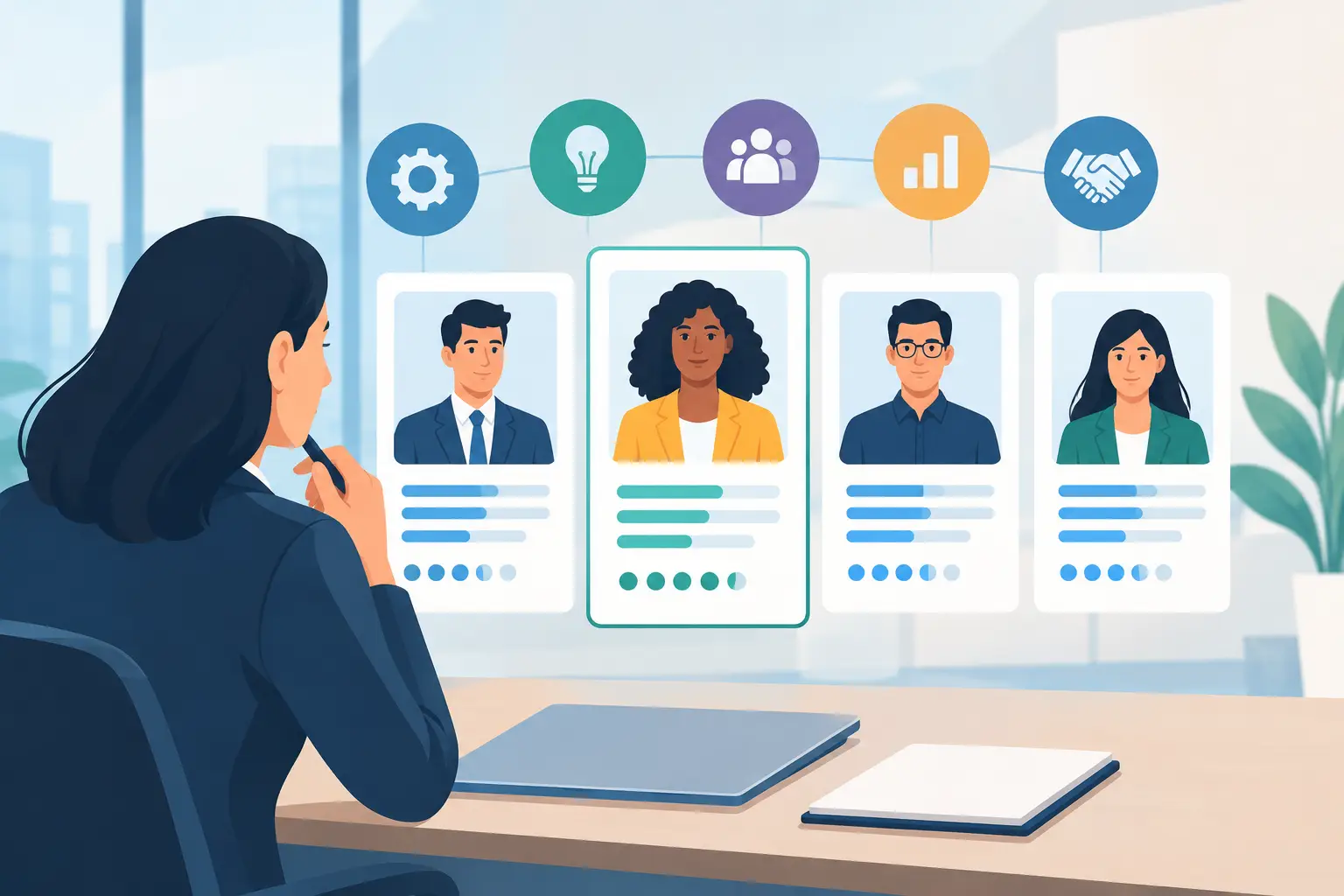
A skills-based hiring initiative can stall before the first role is redesigned. HR may have a skills taxonomy, Talent Acquisition may have an assessment vendor, and business leaders may agree that degree requirements need a rethink. Yet without the right expert to connect job architecture, selection design, workforce planning, and change management, the program becomes another promising framework that never changes hiring decisions.
The best skills based hiring experts do more than update job descriptions or recommend a platform. They build an operating model that helps leaders define the capabilities that matter, measure them credibly, and use the results consistently across recruiting, internal mobility, development, and succession. For enterprise teams under pressure to show progress quickly, that distinction determines whether the work creates measurable value or more process.
What the best skills based hiring experts actually do
Skills-based hiring is often presented as a Talent Acquisition project. It is broader than that. A strong program requires decisions about how the organization defines skills, validates proficiency, designs fair assessments, trains hiring managers, governs data, and integrates new practices with existing HR systems.
The best experts bring enough range to see the full system while staying practical about where to start. They can translate a workforce strategy into role-level skills requirements, then turn those requirements into selection methods that hiring teams can use without adding weeks to the recruiting cycle.
At a minimum, an experienced skills-based hiring consultant should be able to diagnose four connected areas:
- Job and skills architecture: Which roles should be redesigned first, which skills are truly predictive of performance, and how proficiency should be defined.
- Selection design: How structured interviews, work samples, simulations, technical assessments, and validated screening criteria should work together.
- Technology and data: How skills data moves across the ATS, HRIS, talent marketplace, learning ecosystem, and people analytics environment.
- Adoption and governance: Who owns decisions, how managers are trained, how compliance requirements are met, and how outcomes are monitored.
A specialist does not need to own every workstream personally. In a large transformation, you may need a job architecture lead, an assessment scientist, an HRIS or ATS implementation expert, and a change management advisor. The key is having a lead who can make those workstreams operate as one program rather than four disconnected vendor projects.
Start with the business problem, not a skills library
A common failure point is beginning with a massive enterprise-wide skills inventory. It sounds comprehensive, but it can consume months before the organization has improved a single hiring decision. The better approach is to choose a business-critical use case where a skills-based model can prove its value.
That could be reducing time to proficiency for frontline managers, expanding the candidate pool for hard-to-fill technical roles, improving quality of hire in a growing sales organization, or creating clearer internal pathways into digital roles. The right expert will challenge a vague goal such as “become skills-based” and turn it into an operational outcome with a baseline and target.
For example, an organization struggling to hire cybersecurity analysts may discover that a degree requirement and years-of-experience threshold are excluding qualified candidates with adjacent technical experience. A skills-based hiring expert can identify the capabilities that predict success, develop a realistic work sample, calibrate interviewers, and monitor adverse impact. That is a focused intervention with a clear hiring outcome - not a theoretical taxonomy exercise.
How to evaluate skills-based hiring expertise
Credentials and polished presentations are not enough. Ask candidates to explain what they have personally built, implemented, and measured. The strongest consultants can describe the trade-offs behind their recommendations, including when an assessment is too burdensome, when automation introduces risk, or when a role is not ready for a skills-first redesign.
Look for enterprise implementation experience
A consultant who has advised on skills strategy may be valuable, but strategy alone will not solve the execution challenge. Prioritize experts who have worked through the difficult parts of implementation: stakeholder disagreement over role definitions, hiring manager resistance, ATS constraints, data-quality gaps, union or regulatory considerations, and legal review of selection tools.
Ask for examples that resemble your environment. A high-volume hourly hiring model needs a different design than executive hiring, clinical talent, or specialized engineering recruitment. Industry familiarity is useful, but the more important factor is evidence that the expert can adapt a rigorous methodology to your operating reality.
Test their assessment judgment
Skills-based hiring depends on credible signals. If the assessment does not reflect the work, candidates and managers will not trust it. If it is too long, completion rates will drop. If scoring is inconsistent, the organization may create both legal and quality risks.
The right expert understands the strengths and limits of structured interviews, job simulations, work samples, tests, portfolios, and credentialing. They should be able to explain why a particular method fits a role, what validation is appropriate, and how to establish decision rules. Be cautious of anyone who treats one assessment type or AI tool as the answer to every hiring problem.
Evaluate data and technology fluency
Technology should support the operating model, not dictate it. An expert does not need to be a software engineer, but they should understand how skill definitions, proficiency data, candidate profiles, requisitions, and assessment results connect across your systems.
This matters because a pilot can look successful in a spreadsheet and fail at scale when recruiters have to duplicate data, managers cannot see results in their workflow, or reporting cannot distinguish skills-based hires from conventional hires. Your expert should know what configuration, integration, data governance, and reporting requirements to address before rollout.
Assess their ability to drive adoption
Hiring managers make the program real. If they continue to select candidates based on pedigree, familiar employers, or unstructured interview impressions, a new skills framework will have limited impact.
Look for an expert who has led manager enablement, interviewer calibration, communication planning, and performance support. They should have a clear point of view on what managers need to learn, what can be embedded in workflow, and how leaders will reinforce the change. Adoption is not a launch email. It is a set of repeatable behaviors supported by clear tools and accountability.
Build the right expert bench for the work ahead
The best engagement model depends on the scope. For a targeted pilot, a fractional skills-based hiring strategist with assessment expertise may be enough. For an enterprise transformation, you may need a program lead supported by job architecture, HR technology, people analytics, and organizational change specialists.
This is where traditional consulting models can create unnecessary cost and delay. Large firms often staff broad transformation teams, run lengthy discovery phases, and add layers between the people doing the work and your internal team. Generic freelance marketplaces create the opposite risk: fast access, but inconsistent quality and little confidence that a consultant has delivered at enterprise scale.
A curated expert marketplace gives teams a more practical middle path. Learnexus connects organizations with vetted independent L&D, HR, and Talent specialists who can be matched by domain, industry, and tool experience. That makes it possible to bring in a senior job architecture advisor for the design phase, an assessment specialist for selection methods, or a fractional talent transformation lead to run the program - without committing to a large-firm model.
The advantage is not simply lower cost. It is direct access to the person accountable for the work, faster project starts, and the flexibility to expand or adjust the team as the program moves from design to implementation.
Questions to ask before you hire
Use the selection process to reveal how an expert thinks. Ask which roles they would prioritize and why. Ask how they would distinguish skills that are essential on day one from capabilities that can be developed after hire. Ask what data they would need before recommending an assessment, and how they would evaluate success after launch.
You should also ask what they would not do in the first 90 days. Strong experts know that an enterprise-wide taxonomy rebuild, system replacement, and global rollout may all be worthwhile eventually, but not necessarily at the beginning. They will help you sequence the work around business urgency, organizational capacity, and risk.
Finally, require a practical plan. It should define the pilot population, decision makers, deliverables, technology dependencies, manager enablement approach, measures of success, and rollout criteria. If a proposal cannot connect activities to outcomes such as qualified applicant volume, time to hire, quality of hire, internal mobility, or retention, it is not ready for procurement.
Make the first win visible
Skills-based hiring earns credibility when employees, candidates, and business leaders can see a better decision being made. Start where the need is acute, establish a disciplined baseline, and give the program enough support to change real workflows. Then use the evidence to decide what scales next.
The right expert will not sell a generic model. They will help your organization make hiring more precise, more equitable, and more responsive to the capabilities the business actually needs.