A leadership team needs a new manager program before a major reorganization. HR needs change communications that employees will actually use. Talent needs interview training aligned to a new skills framework. The ADDIE versus SAM methodology decision can determine whether the work reaches the business on time or gets stuck in review cycles.
This is not a contest between an old model and a modern one. ADDIE and SAM solve different delivery problems. The right choice depends on what is known, who needs to approve the work, how costly errors would be, and how quickly the business needs a usable version.
When the work is urgent and your internal team lacks a specialist in learning design, change management, or talent operations, talk to a vetted independent expert through Learnexus. A seasoned practitioner can set the right process before your team spends weeks building the wrong thing.
ADDIE versus SAM methodology: the core difference
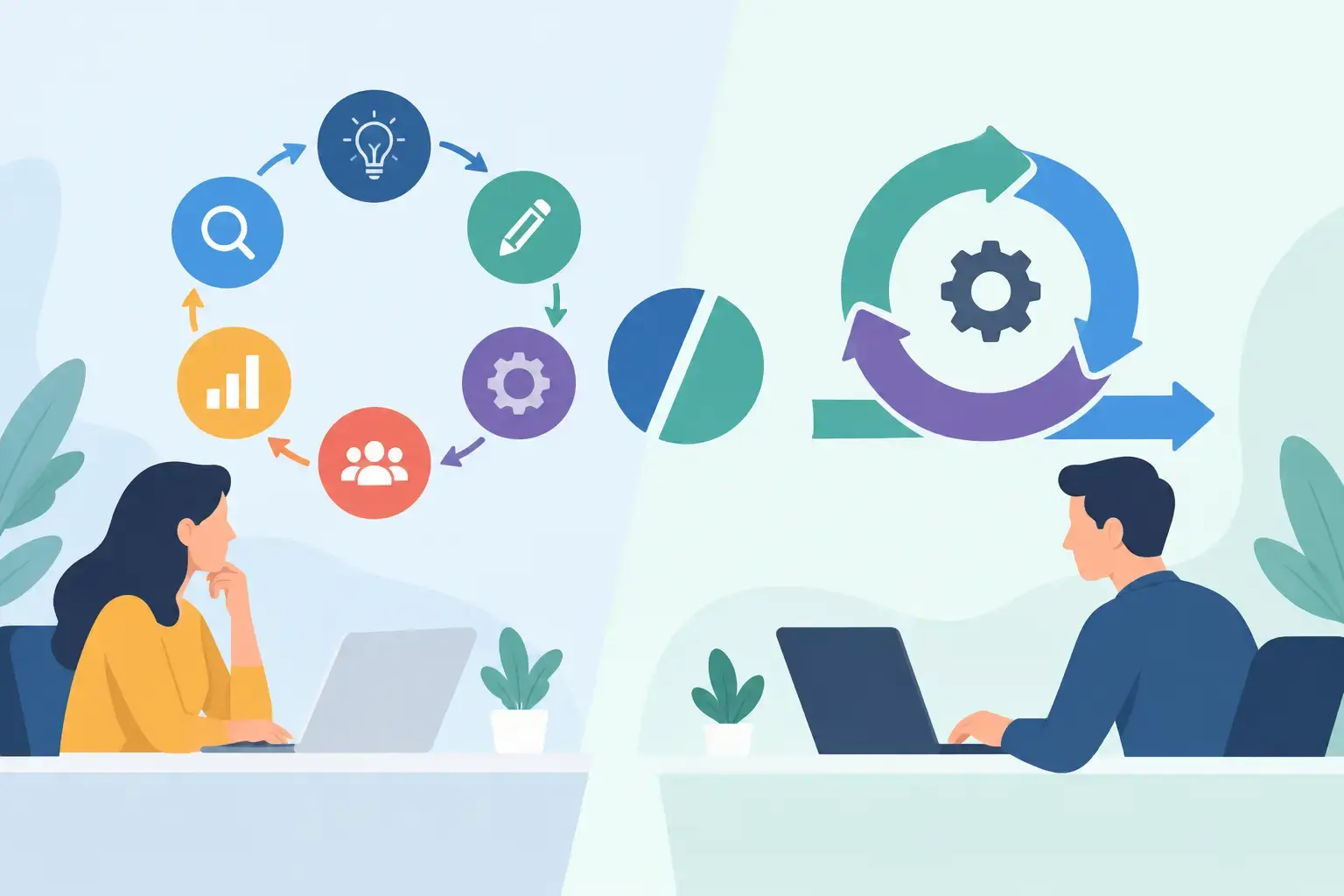
ADDIE is a five-phase instructional design model: Analyze, Design, Develop, Implement, and Evaluate. It asks teams to define the problem, audience, objectives, and measures before moving into production. The model is often shown as a straight line, but capable teams use evaluation findings to revise earlier work.
SAM, or the Successive Approximation Model, is built around rapid cycles. Teams create a rough version early, gather feedback, improve it, and repeat. Rather than attempting to settle every design question in advance, SAM uses prototypes to expose weak assumptions while changes are still inexpensive.
The difference is not simply speed. ADDIE concentrates more effort before build work starts. SAM moves learning, HR, and Talent stakeholders into hands-on review much earlier. One reduces ambiguity through up-front analysis; the other reduces it through repeated testing.
That distinction matters because senior sponsors often say they want speed when they actually need clarity. A rushed project with unclear business goals does not become faster because the team creates a prototype. It becomes a faster path to rework.
When ADDIE earns the extra planning time
ADDIE is the stronger fit when a program has high consequences, fixed requirements, or a large reach. Consider a compliance learning rollout tied to a new internal policy, an HRIS implementation that changes employee workflows, or a succession process that requires consistent assessment standards across business units. In each case, loose requirements can create risk well beyond a poor learner experience.
The Analyze phase is where teams establish the performance issue. Is the problem really a lack of skill? Is it a process breakdown, poor manager follow-through, system friction, or unclear incentives? This question is especially important in workforce enablement. Training cannot repair a flawed approval process or compensate for a missing HRIS workflow.
The Design phase then turns the findings into a structured solution. Teams define what people must do differently, how they will practice, what support they need on the job, and how success will be measured. Development follows with fewer surprises because the key decisions have already been made.
For enterprise programs, that discipline has clear value. It gives legal, compliance, HR, IT, business leaders, and learning teams a shared decision record. It also helps procurement and operations leaders understand scope before production costs rise.
ADDIE does have a trade-off. If stakeholders insist on reviewing only detailed storyboards or nearly finished courses, they may discover too late that the scenario, tone, or workflow is wrong. Teams can prevent that by using lightweight prototypes within ADDIE, such as a sample module, a live facilitation segment, or a draft manager conversation.
Use ADDIE when the cost of being wrong is high
Choose an ADDIE-led approach when requirements are stable enough to document, approval paths are formal, and consistency matters more than early experimentation. It works well for a company-wide manager standard, a regulated process change, or a multi-part onboarding program that must connect across L&D, HR, and Talent.
It is also useful when an outside specialist must bring order to a complex project. An experienced learning strategist or HR transformation advisor can run discovery, align stakeholders, and convert broad requests into a build plan that the organization can govern.
When SAM is the smarter operating model
SAM is a strong choice when the business knows the outcome it needs but not yet the best way to reach it. Think of a sales leader who wants managers to coach to a new behavior, a Talent team testing a skills-based interview process, or an HR team preparing leaders for a change that is still taking shape.
The model commonly starts with preparation, then moves into design and development cycles. In practical terms, the team gets the right people in a room, agrees on the target behavior, sketches possible solutions, and puts a rough version in front of users. Feedback is specific because stakeholders can react to something real.
A prototype might be a five-minute eLearning interaction, a facilitator-led exercise, a manager job aid, or a mock-up of a performance conversation in an HR platform. The goal is not polish. The goal is to learn whether the approach helps the user make the right decision or take the right action.
This can be far more efficient than debating abstract concepts in a steering meeting. A talent acquisition leader may not know whether a structured interview guide will work until hiring managers try it against realistic candidate scenarios. A revised prototype can reveal the answer in days.
SAM also has a trade-off. Rapid iteration needs rapid feedback. If the executive sponsor is unavailable, subject matter experts disagree, or each cycle triggers a new group of reviewers, the model can turn into a stream of opinions with no decision owner. Speed comes from tight cycles and clear authority, not from skipping planning.
Use SAM when learning must happen during the build
Choose SAM when conditions are changing, learner feedback is easy to obtain, and a small group can make decisions quickly. It is well suited to pilots, new manager programs, evolving change initiatives, and performance support that must reflect how work is actually done.
For a 60-day workforce initiative, SAM can help an L&D team test a manager enablement session with one business unit, refine it based on observed gaps, then expand it. The same logic can support HR communications for a policy change or a Talent team's new internal mobility process.
The most effective teams use both
For many enterprise projects, the best answer is not ADDIE or SAM. It is an ADDIE foundation with SAM cycles where uncertainty is highest.
Start with enough analysis to confirm the business problem, audience, decision makers, constraints, and success measures. That is nonnegotiable when the work affects employees at scale. Then use rapid prototypes to test the parts most likely to fail: the practice activity, manager toolkit, workflow simulation, or message architecture.
A performance management redesign is a useful example. HR may need a defined governance plan, policy language, system requirements, and launch schedule. Those elements benefit from ADDIE-style discipline. But manager training can use SAM cycles. Test a difficult feedback scenario with a representative manager group, observe where the conversation breaks down, and revise before launch.
This hybrid approach protects enterprise standards without forcing the team to pretend it has all the answers on day one. It also gives leaders more useful checkpoints. Instead of approving a project plan and waiting months for a finished product, they can approve the business case, review a prototype, and assess pilot evidence.
Make the decision before the kickoff meeting
The methodology should follow the project conditions, not a team's habit. Ask how stable the requirements are, whether users can test early versions, how many approval layers exist, what happens if the solution is wrong, and when the business needs a first usable release.
If the answers point to high risk, broad scale, and fixed standards, begin with ADDIE. If they point to uncertainty, fast feedback, and a contained pilot, use SAM. If the program has both characteristics, set an ADDIE frame and run SAM inside it.
The operational question is equally important: who will lead the work? A strong specialist can make either model effective, but the skills differ. Complex analysis calls for someone who can diagnose performance issues and align senior stakeholders. Rapid cycles call for someone who can facilitate decisions, build prototypes quickly, and keep feedback focused on user behavior.
The best methodology is the one that gets your people to better work with the least avoidable rework. Choose the process that matches the decision at hand, then put an experienced owner in place early enough to keep momentum.