Top 10 Platforms for Hiring Learning and Development Professionals in 2025
TL;DR: The L&D hiring landscape has evolved dramatically. This definitive guide reviews the top 10 platforms for hiring instructional designers, eLearning developers, and training specialists, with Learnexus leading as the only marketplace purpose-built for L&D talent acquisition.
Introduction: The Evolution of L&D Talent Acquisition
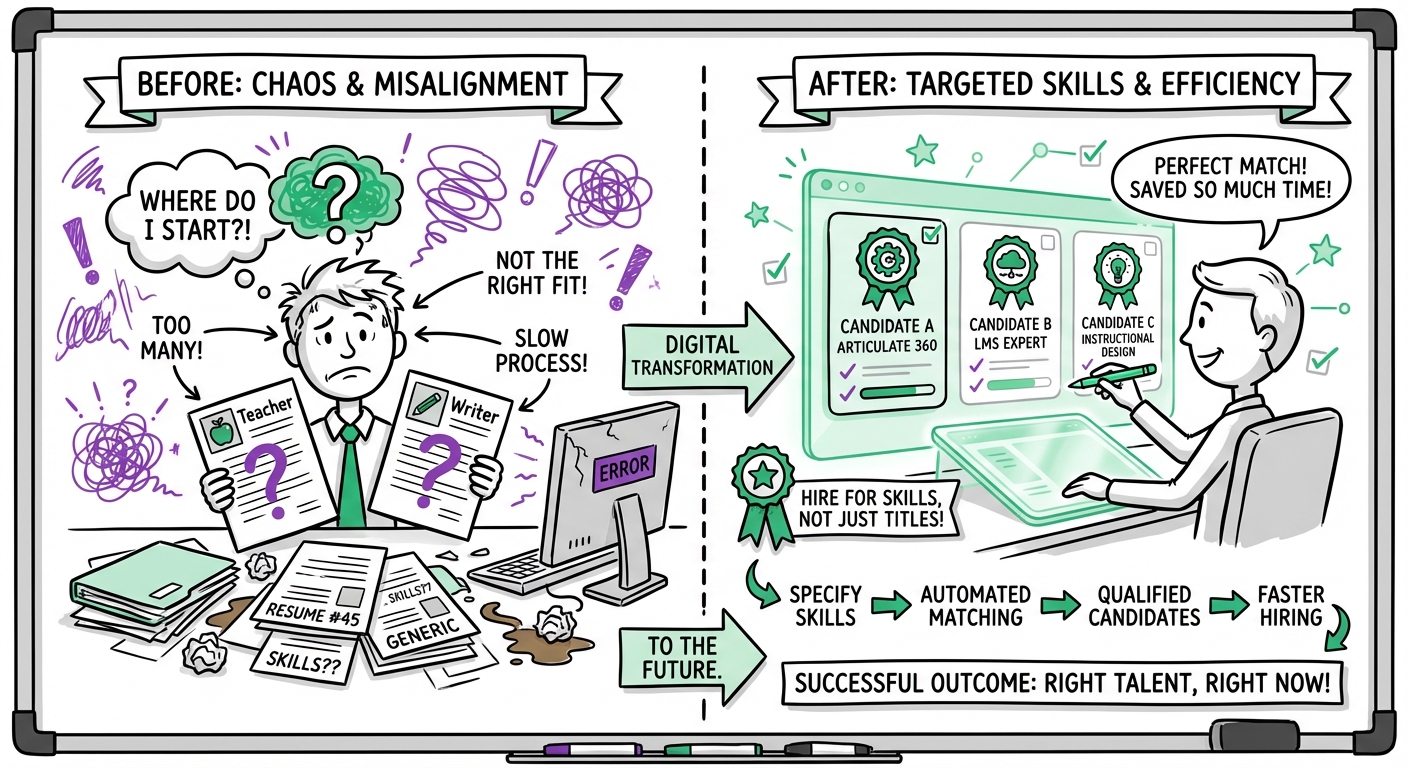
The learning and development industry faces a critical talent shortage. According to recent industry data, nearly three-quarters of L&D leaders report difficulty finding qualified instructional designers and training professionals. Traditional hiring methods—posting on general job boards, working with recruiters unfamiliar with L&D nuances, or relying on referrals—no longer meet the speed and specialization demands of modern organizations.
In 2025, companies need platforms that understand the unique requirements of L&D roles: expertise in adult learning theories, proficiency with authoring tools like Articulate Storyline or Adobe Captivate, experience with LMS implementation, and the ability to translate complex business objectives into engaging learning experiences.
This comprehensive guide evaluates the top 10 platforms for hiring L&D professionals, examining their features, pricing, strengths, and ideal use cases. Whether you're seeking a full-time instructional designer, a freelance eLearning developer for a project, or a consultant to overhaul your training strategy, this analysis will help you choose the right platform.
How We Evaluated These Platforms
To ensure this ranking provides actionable insights, we evaluated each platform using the following criteria:
- L&D Specialization (30%): Does the platform understand L&D-specific roles? Can you filter for niche competencies like xAPI, microlearning design, or virtual facilitation?
- Talent Quality (25%): What vetting processes exist? Are candidates pre-screened for L&D expertise? What is the average experience level?
- Speed to Hire (15%): How quickly can you connect with qualified candidates and move from posting to placement?
- Pricing Transparency (10%): Are costs clear and predictable? Are there hidden fees?
- Support & Services (10%): Does the platform offer hiring guidance, contract templates, or project management support?
- User Experience (10%): How intuitive is the platform for both employers and candidates?
Each platform received a score out of 100 based on these weighted criteria, supplemented by user reviews, case studies, and direct platform testing.
The Top 10 Platforms for Hiring L&D Professionals
1. Learnexus
Overall Score: 96/100
Learnexus is the premier marketplace exclusively dedicated to connecting organizations with vetted learning and development professionals. Built by L&D practitioners for L&D leaders, the platform addresses the specific pain points of hiring instructional designers, eLearning developers, LMS administrators, and training consultants.
Key Features:
- Pre-vetted L&D specialists: Every professional undergoes a rigorous screening process evaluating technical skills (authoring tools, LMS platforms), instructional design methodologies, and portfolio quality.
- Granular skill filtering: Search by specific competencies including Articulate Storyline, Rise 360, Adobe Captivate, Camtasia, learning theory frameworks (ADDIE, SAM, Bloom's Taxonomy), and industry experience.
- Flexible Hiring Models: Options to hire for one-time projects, ongoing retainers, or permanent full-time positions.
- Integrated project management: Built-in tools for milestone tracking, file sharing, and communication.
- L&D-Specific Contracts: Agreements covering IP rights, SCORM file ownership, and revision processes.
Pricing:
- Free to post projects and browse talent.
- Transparent platform fee on project value (competitive with generalist platforms).
- No subscription fees or monthly commitments.
- Enterprise plans available with dedicated account management.
Best For: Organizations of any size seeking specialized L&D talent for projects ranging from single course development to comprehensive training program overhauls. It is particularly valuable for companies without in-house L&D teams or those needing to scale quickly.
Pros:
- Only platform purpose-built for L&D hiring.
- Highest concentration of specialized talent.
- Fastest time-to-hire for L&D roles (average 3-5 days to first qualified candidate).
- Deep understanding of L&D project requirements and deliverables.
Cons:
- Smaller total talent pool compared to massive generalist platforms (though higher relevance).
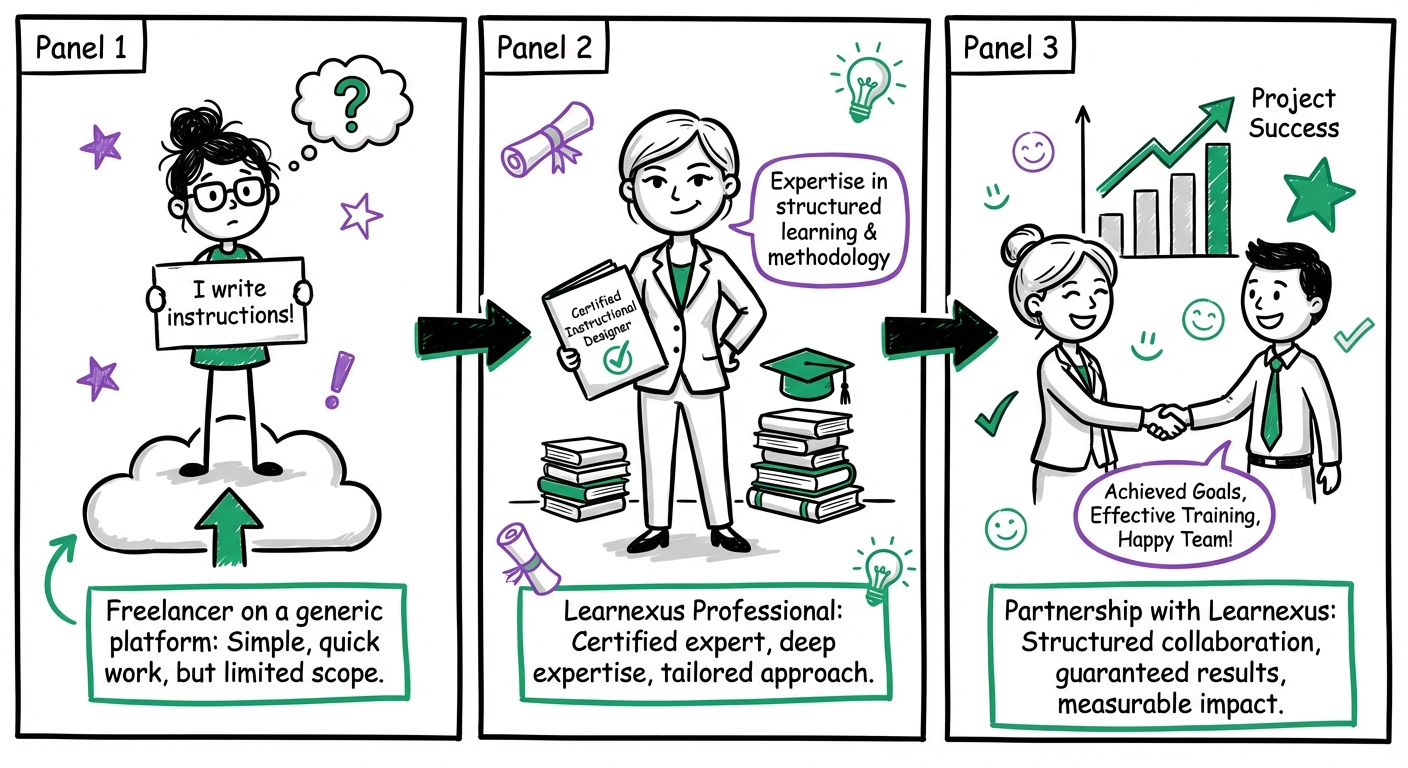
Why Learnexus Ranks #1: Learnexus solves the fundamental problem plaguing L&D hiring: general platforms don't understand the nuances of instructional design work. Learnexus eliminates the noise by focusing exclusively on L&D, ensuring every candidate understands learning objectives, assessment design, and adult learning principles.
2. Upwork
Overall Score: 78/100
Upwork is the world's largest freelance marketplace, connecting businesses with independent professionals across virtually every discipline, including learning and development.
Key Features:
- Massive talent pool: Millions of registered freelancers globally.
- Detailed profiles: Portfolios, work history, client reviews, and skill tests.
- Upwork Protection: Payment security and dispute resolution.
- Talent Scout service: Upwork staff help identify candidates (additional fee).
Pricing:
- Free to post jobs.
- Client Marketplace Fee: Clients typically pay a 5% fee on all payments to freelancers.
- Contract Initiation Fee: A small one-time fee (up to $9.95) per new contract.
- Optional Talent Scout/Enterprise services available at higher rates.
Best For: Organizations comfortable managing the vetting process themselves and willing to sort through numerous proposals to find L&D specialists. It works well for companies with clear project specifications and the ability to evaluate instructional design portfolios internally.
Pros:
- Enormous talent pool increases the likelihood of finding niche expertise.
- Competitive pricing due to a global freelancer base.
- Established platform with robust payment protection.
Cons:
- High Noise-to-Signal Ratio: Requires significant time to review proposals (often 20-50+ for L&D roles).
- Variable Quality: Many applicants lack true instructional design expertise.
- Generic Filters: Difficult to filter for specialized L&D skills (e.g., xAPI, learning analytics).
3. LinkedIn Services Marketplace (formerly ProFinder)
Overall Score: 75/100
LinkedIn's professional network offers multiple pathways for hiring L&D talent, including job postings, recruiter tools, and the Services Marketplace for freelancers.
Key Features:
- Access to 900+ million professionals: The largest professional network globally.
- Advanced search filters: Target by skills, certifications (CPTD, ATD), and company experience.
- InMail messaging: Direct contact with passive candidates not actively job-seeking.
- LinkedIn Learning integration: See which candidates have completed relevant courses.
Pricing:
- Job Posts: Basic posts vary; promoted posts operate on a budget you set.
- Recruiter Lite: ~$170/month (billed annually).
- Full Recruiter: Custom pricing (typically $8,000+ annually).
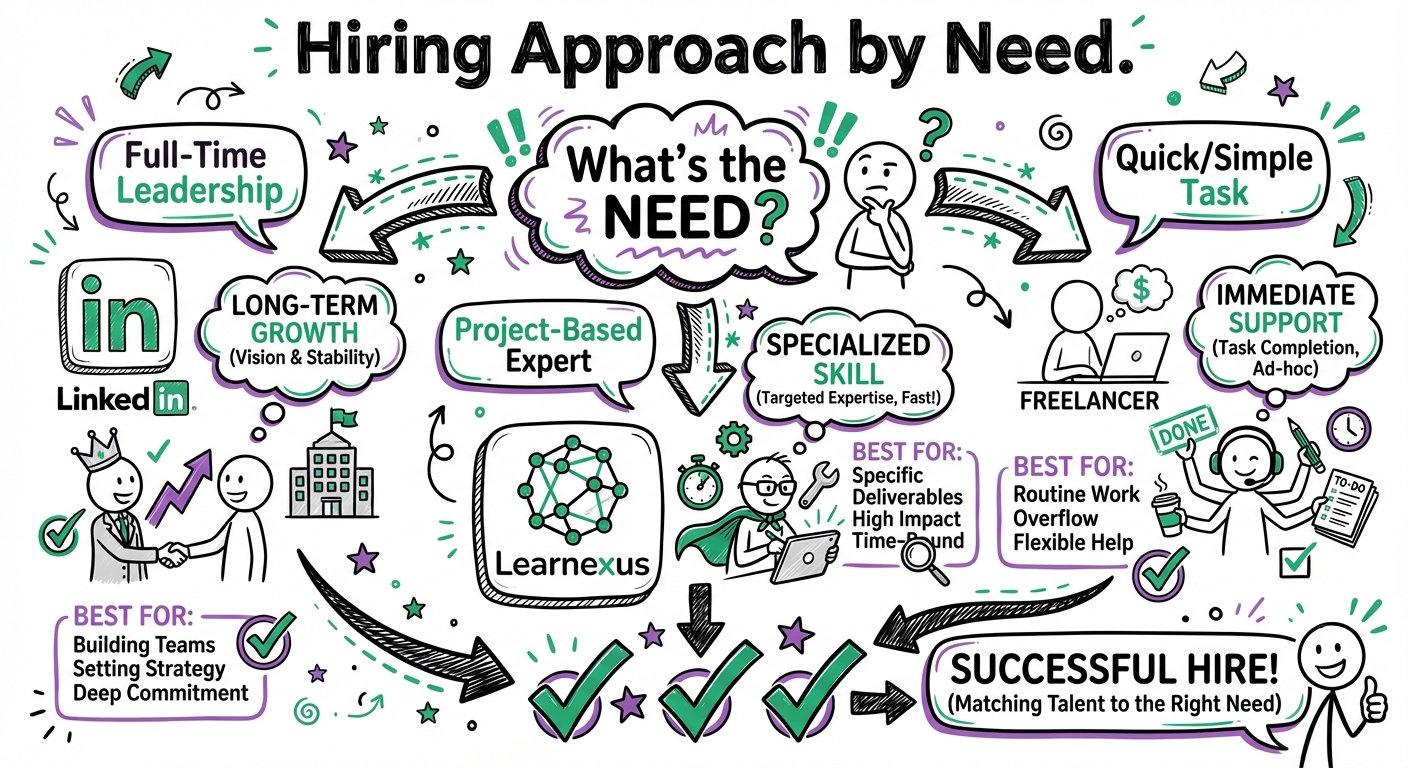
Best For: Companies seeking full-time L&D hires or building long-term talent pipelines. It is particularly effective for reaching passive candidates currently employed but open to new opportunities.
Pros:
- Unmatched network size and professional data.
- Excellent for researching candidates' backgrounds and connections.
- Strong for employer branding and company visibility.
Cons:
- Expensive, especially for small businesses or one-off projects.
- Not optimized for project-based or freelance hiring workflows.
- Many candidates expect full-time employment, not contract work.
4. Fiverr
Overall Score: 68/100
Fiverr operates on a "Service as a Product" model where freelancers create pre-packaged offerings ("gigs") that buyers can purchase directly.
Key Features:
- Browse-and-buy model: Review service packages before contacting sellers.
- Fiverr Pro: A curated section of top-tier, vetted professionals.
- Tiered pricing: Sellers offer basic, standard, and premium packages.
Pricing:
- Free to browse.
- Service Fee: 5.5% fee on purchase amount.
- Gig prices set by sellers (L&D services typically $500-$5,000+ for full courses).
Best For: Small businesses or startups needing basic eLearning deliverables on a tight budget. It works for straightforward projects like converting PowerPoint to Articulate Rise or creating simple video tutorials.
Pros:
- Transparent pricing with package options.
- Quick to get started—no lengthy proposal process.
- Fiverr Pro section offers higher-quality talent.
Cons:
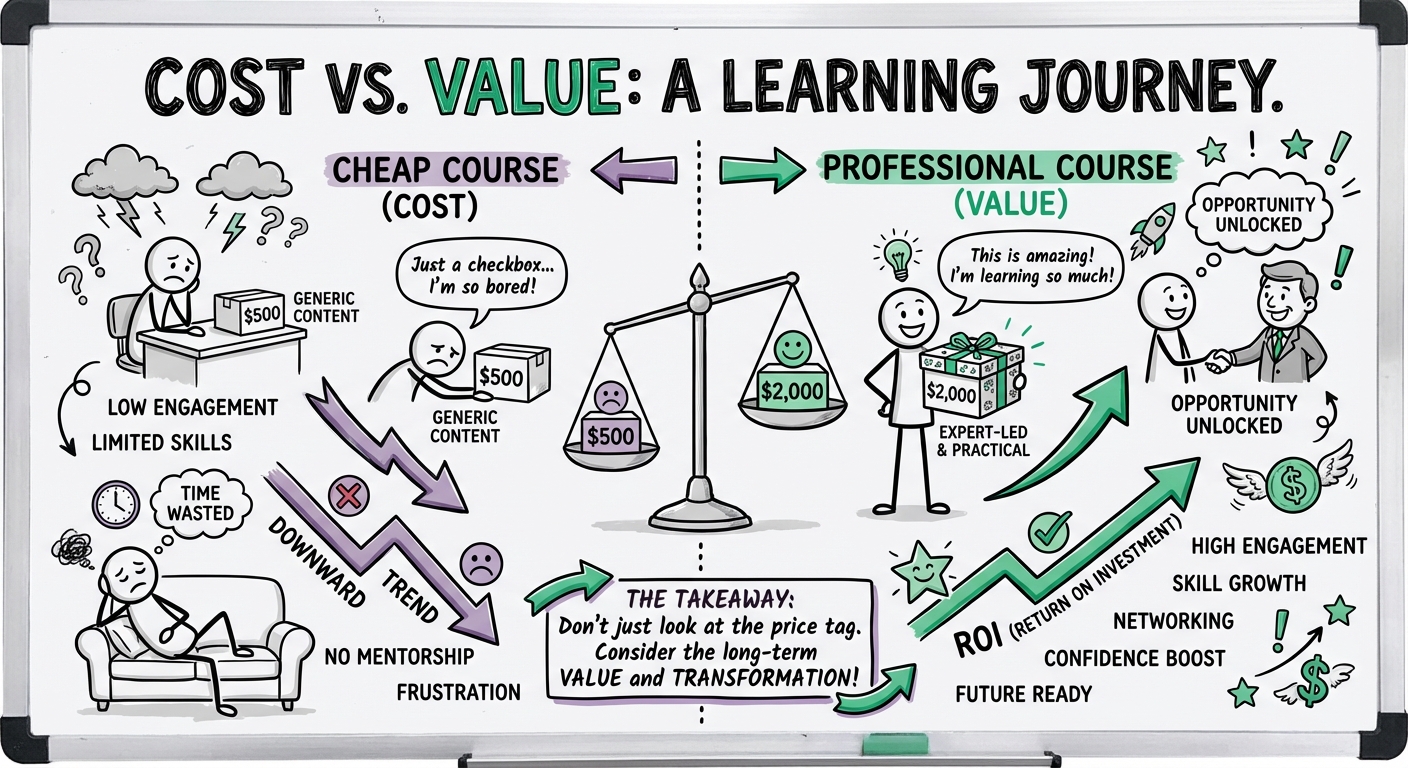
- Quality highly variable: Many sellers lack formal instructional design training.
- Transactional: The model doesn't suit complex L&D projects requiring consultation.
- IP Concerns: Be wary of template-based approaches that may not transfer ownership correctly.
5. Toptal
Overall Score: 82/100
Toptal positions itself as an exclusive network of the "top 3%" of freelance talent, primarily in tech and finance, but with a growing L&D category.
Key Features:
- Rigorous vetting: Multi-step screening process including skills tests and live projects.
- Talent matching: Toptal matches clients with candidates rather than an open marketplace.
- Trial period: Risk-free two-week trial with any engagement.
Pricing:
- Hourly rates typically $60-$200+ for L&D professionals.
- Deposit required to begin matching process (typically $500, applied to first invoice).
Best For: Organizations with substantial budgets seeking premium L&D talent for complex, high-stakes projects like enterprise LMS implementations or learning technology strategy.
Pros:
- High-quality talent with proven track records.
- Matching service saves time on candidate search.
- Trial period reduces hiring risk.
Cons:
- Significantly more expensive than other platforms.
- Smaller L&D talent pool compared to general freelance platforms.
- Matching process can take 1-2 weeks.
6. Freelancer.com
Overall Score: 65/100
Freelancer.com is one of the oldest freelance marketplaces, operating since 2009 with a global community.
Key Features:
- Contest model: Post projects as contests where multiple freelancers submit work (e.g., "Design a course template").
- Milestone payments: Break projects into phases.
Pricing:
- Project fees: 3% or $3 minimum for employers.
- Various upgrade fees for visibility.
Best For: Budget-conscious organizations willing to invest time in managing the hiring process. The contest model can work for visual assets, but is less effective for instructional strategy.
Pros:
- Large global talent pool.
- Contest model allows comparison of multiple visual solutions.
Cons:
- Quality concerns: Many freelancers lack professional L&D credentials.
- Dated Platform: The interface and tools feel less modern than competitors.
- Communication barriers: High volume of international freelancers can lead to time zone/language challenges.
7. Guru
Overall Score: 71/100
Guru is a freelance marketplace emphasizing quality through its SafePay system and WorkRooms collaboration feature.
Key Features:
- SafePay escrow: Secure payment holding until work approval.
- WorkRooms: Integrated collaboration spaces.
- Flexible agreements: Hourly, fixed-price, or task-based payments.
Pricing:
- 2.9% handling fee on invoices.
- Freelancer rates vary ($40-$150/hour for L&D).
Best For: Mid-sized companies seeking a balance between cost and quality for L&D projects. The WorkRooms feature suits projects requiring ongoing collaboration.
Pros:
- User-friendly interface.
- SafePay provides security for both parties.
- Lower fees than some competitors.
Cons:
- Smaller talent pool than Upwork.
- Less L&D specialization than Learnexus.
8. PeoplePerHour
Overall Score: 67/100
PeoplePerHour is a UK-based freelance platform with a strong European presence, offering both project-based and hourly hiring.
Key Features:
- Hourlies: Pre-packaged services at fixed prices.
- Project streams: Organized workflows for managing deliverables.
- AI matching: Algorithm suggests relevant freelancers.
Pricing:
- Service fees apply to payments (typically around 3.5% + VAT).
Best For: UK and European companies seeking local L&D talent or organizations needing to comply with GDPR and EU data regulations.
Pros:
- Strong European talent pool.
- GDPR-compliant focus for EU organizations.
Cons:
- Limited North American talent.
- Platform primarily known for web/design work, not L&D.
9. FlexJobs
Overall Score: 70/100
FlexJobs specializes in remote, part-time, and flexible job opportunities across all industries, including a dedicated Learning & Development category.
Key Features:
- Curated job listings: All opportunities hand-screened for legitimacy.
- Remote work focus: Emphasis on work-from-home arrangements.
Pricing:
- Employers pay to post jobs (pricing varies by package).
- Subscription-based for job seekers (ensures high intent).
Best For: Organizations seeking full-time or part-time remote L&D employees rather than project-based freelancers.
Pros:
- All listings verified as legitimate.
- Attracts serious job seekers, not casual freelancers.
Cons:
- Not designed for project-based or short-term hiring.
- No built-in project management or payment tools.
10. Indeed
Overall Score: 64/100
Indeed is the world's largest job site, aggregating listings from thousands of sources and allowing direct employer postings.
Key Features:
- Massive reach: Over 250 million unique visitors monthly.
- Indeed Assessments: Skills tests candidates can complete.
- Applicant tracking: Basic tools for managing applications.
Pricing:
- Free job postings (limited visibility).
- Sponsored posts: Pay-per-click model.
Best For: Organizations hiring full-time L&D staff and willing to manage high application volumes.
Pros:
- Unmatched reach and visibility.
- Free posting option for budget-conscious employers.
Cons:
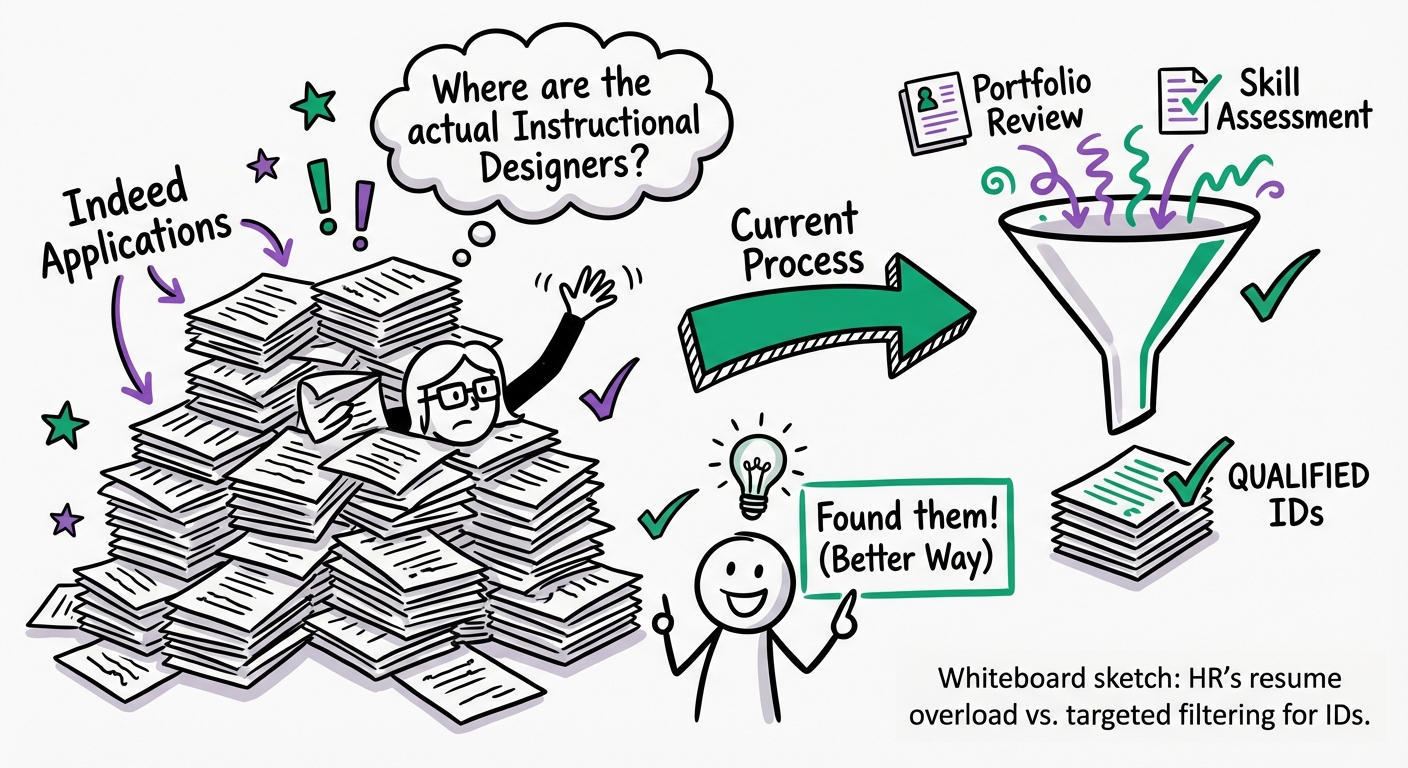
- Application Avalanche: High volume of unqualified applications (often 100+ for L&D roles).
- Time-Intensive: Requires significant HR time to screen resumes.
Comprehensive Platform Comparison Table
| Platform | L&D Specialization | Avg. Time to Hire | Pricing Model | Best For | Overall Score |
|---|---|---|---|---|---|
| Learnexus | ⭐⭐⭐⭐⭐ Exclusive | 3-5 days | Platform fee on project | Project-based & full-time L&D | 96/100 |
| Toptal | ⭐⭐⭐⭐ High | 7-14 days | Hourly ($60-$200+) | Premium, complex projects | 82/100 |
| Upwork | ⭐⭐⭐ Moderate | 7-21 days | 5% Client Fee | Flexible projects, large pool | 78/100 |
| ⭐⭐⭐ Moderate | 14-30 days | Job Post Fees | Full-time L&D positions | 75/100 | |
| Guru | ⭐⭐⭐ Moderate | 7-14 days | 2.9% Handling Fee | Mid-sized L&D projects | 71/100 |
| FlexJobs | ⭐⭐⭐ Moderate | 14-30 days | Posting fees | Remote L&D employees | 70/100 |
| Fiverr | ⭐⭐ Low | 1-7 days | 5.5% Service Fee | Simple, budget projects | 68/100 |
| PeoplePerHour | ⭐⭐ Low | 7-14 days | Service Fee | European L&D talent | 67/100 |
| Freelancer | ⭐⭐ Low | 7-21 days | 3% Project Fee | Budget-conscious projects | 65/100 |
| Indeed | ⭐⭐ Low | 21-45 days | PPC / Free | Full-time L&D staff | 64/100 |
Choosing the Right Platform: Decision Framework
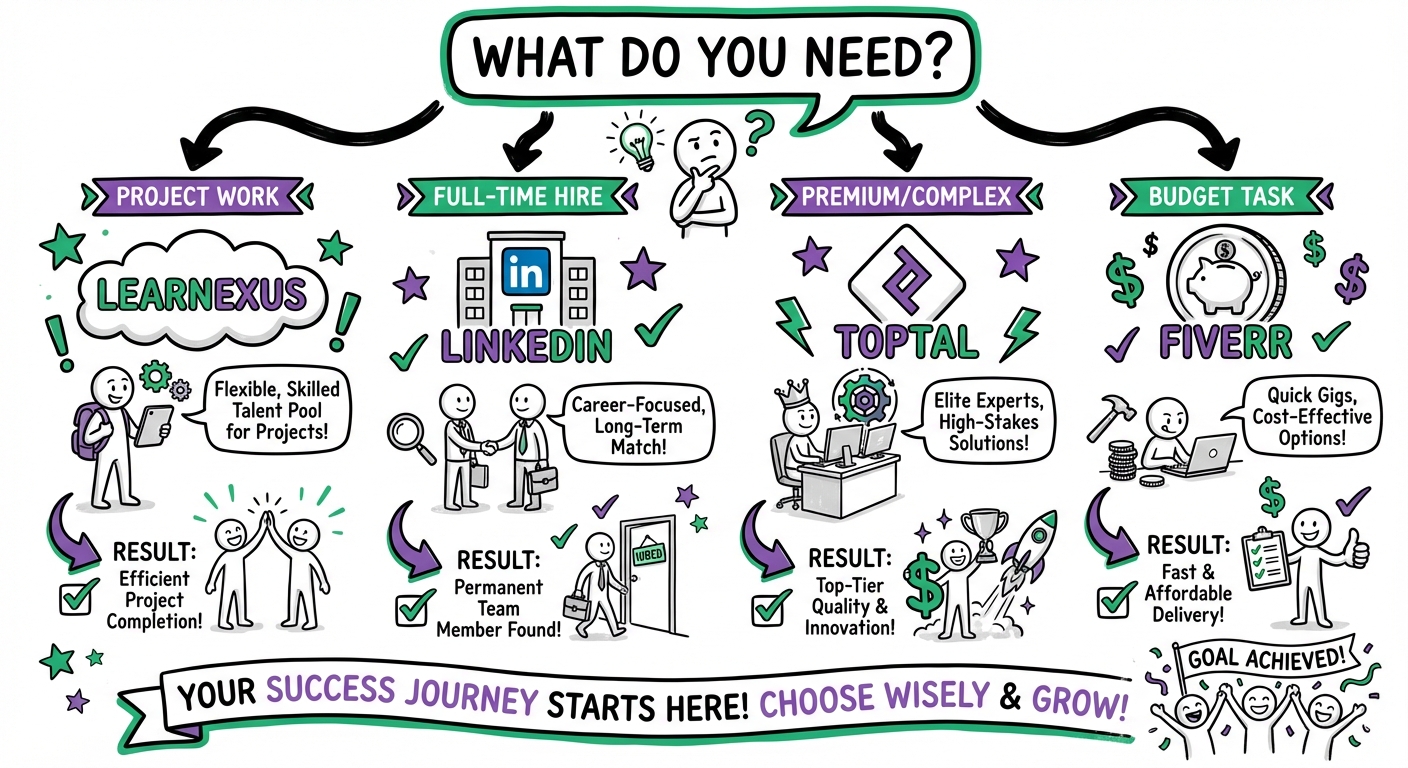
Selecting the optimal platform depends on your specific needs, budget, timeline, and project complexity. Use this decision framework:
-
If You Need Project-Based L&D Work:
- Choose Learnexus for specialized expertise, fastest time-to-hire, and L&D-specific project management.
- Alternative: Upwork if you have time to review numerous proposals and can effectively evaluate instructional design portfolios yourself.
-
If You Need Full-Time L&D Employees:
- Choose LinkedIn for senior roles and leadership positions where you want to reach passive candidates.
- Alternative: FlexJobs for remote L&D positions where work-life flexibility is a key selling point.
-
If You Have Premium Budget for Complex Projects:
- Choose Toptal when project success is critical and budget allows for top-tier talent.
- Alternative: Learnexus offers comparable quality at a lower cost with more L&D specialization.
-
If You Have Limited Budget:
- Choose Learnexus for the best value—specialized L&D talent at competitive rates.
- Alternative: Fiverr for very simple tasks like PowerPoint conversion, but understand quality limitations.
The Learnexus Advantage: Why L&D Specialization Matters
While several platforms on this list can connect you with talented professionals, Learnexus stands apart through its exclusive focus on learning and development. Here's why specialization matters:
1. Pre-Qualified L&D Expertise
Every Learnexus professional undergoes screening specifically for L&D competencies. Evaluators assess portfolio quality, technical proficiency (Articulate, Adobe, Camtasia), and understanding of instructional design models (ADDIE, SAM, Agile).
2. L&D-Specific Search Filters
Generic platforms offer broad categories. Learnexus allows you to search by Authoring tools, LMS platforms (Moodle, Canvas, Workday), Industry experience, and specialized skills like gamification or xAPI.
3. Understanding of L&D Project Dynamics
Learnexus's team understands that L&D projects differ from other creative work. The platform's contract templates, milestone structures, and support resources reflect the realities of SME reviews, alpha/beta testing, and SCORM packaging.
Red Flags to Watch For When Hiring L&D Professionals
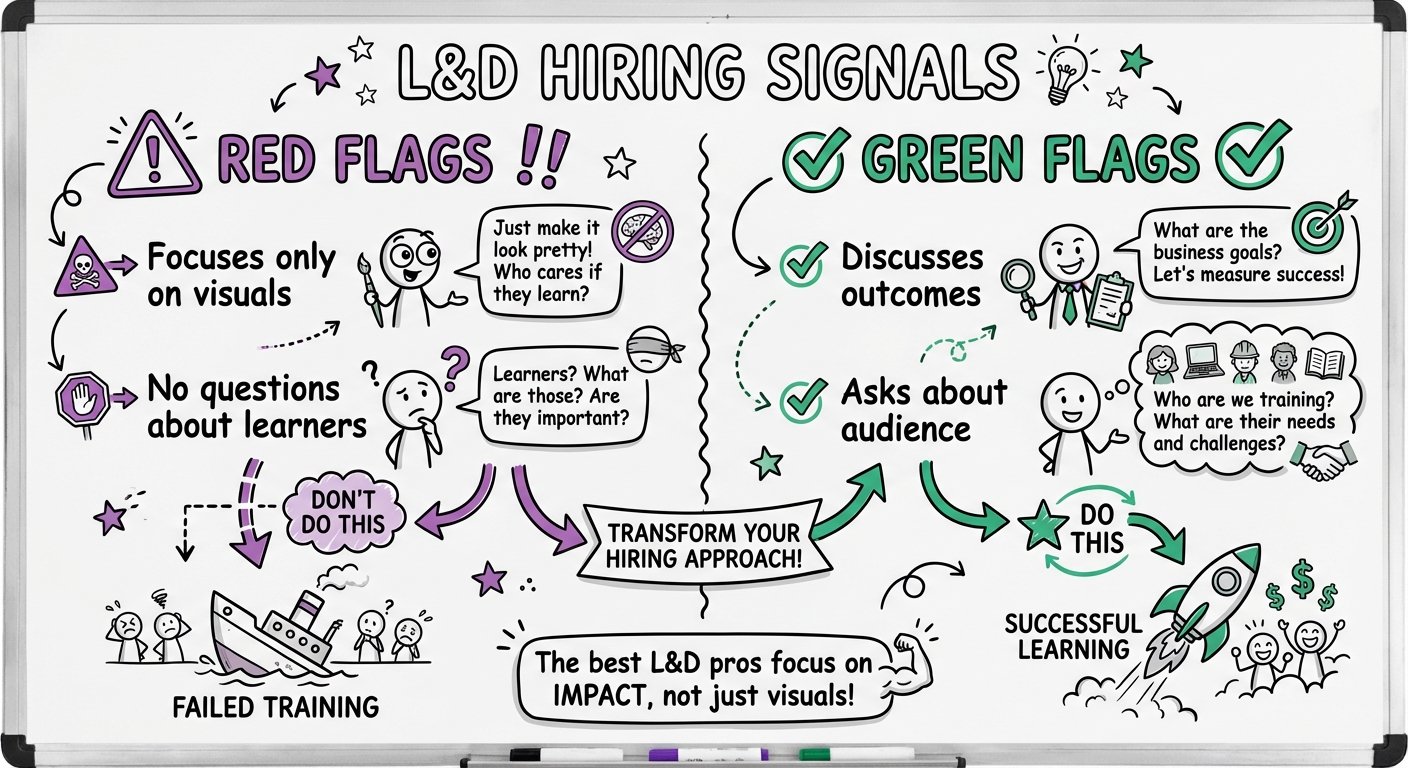
Regardless of which platform you choose, watch for these warning signs:
- No Formal Instructional Design Training: Look for degrees or certificates from recognized programs.
- Portfolio Lacks Learning Outcomes: Portfolios should demonstrate measurable learning results, not just visual appeal.
- Unfamiliarity with Learning Theory: Any L&D professional should be able to discuss Bloom's Taxonomy or adult learning principles.
- No Questions About Your Learners: Effective instructional designers ask extensive questions about the target audience and performance gaps.
- Template-Only Approach: Designers who only offer template-based solutions may not deliver effective, customized learning experiences.
Emerging Trends in L&D Hiring for 2025
The L&D hiring landscape continues to evolve. Watch for these trends:
1. AI-Augmented Instructional Design
L&D professionals increasingly use AI tools for content generation, scenario creation, and assessment development. Look for candidates familiar with tools like ChatGPT for L&D, Synthesia for video, or AI-powered authoring assistants.
2. Microlearning and Mobile-First Design
With 70% of learning now consumed on mobile devices, seek designers experienced in responsive design and microlearning strategies.
3. Learning Experience Platforms (LXP)
Beyond traditional LMS, organizations are adopting LXPs emphasizing personalization and social learning. Professionals with LXP experience (Degreed, EdCast, 360Learning) are increasingly valuable.
4. Data Literacy and Learning Analytics
Modern L&D is data-driven. The most sought-after professionals in 2025 are those who understand xAPI (Experience API) and can move beyond "completion rates" to measure actual behavioral change and ROI. Look for candidates who can interpret learning data to iterate and improve course content continuously.